About the Book
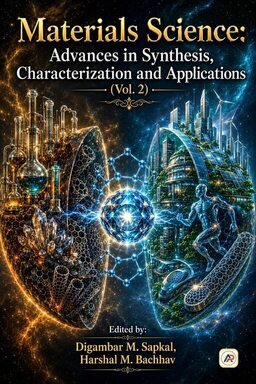
Materials Science: Advances in Synthesis, Characterization and Applications – Vol. 2:, published by : Advent Publishing, is a comprehensive peer-reviewed edited volume that showcases state-of-the-art research at the forefront of modern materials science. With a distinct focus on chemical and green synthesis methods, this volume explores novel techniques—including sol-gel, hydrothermal, and biomimetic approaches—for creating materials with unique and tunable properties. The book covers the complete lifecycle of materials, from synthesis and advanced characterization to practical applications across diverse domains. Dedicated sections address nanomaterials and nanostructures, energy generation and storage materials, biomaterials for healthcare and implants, and smart adaptive structures. Adopting a truly interdisciplinary lens, it bridges contributions from physics, chemistry, biology, engineering, and related fields to offer both fundamental theoretical insights and applied research outcomes. Each chapter will be assigned a unique Digital Object Identifier (DOI) to ensure global discoverability, seamless citation, and robust indexing. Emerging trends and future directions are critically examined, providing a forward-looking perspective on industrial challenges and opportunities. This volume is an indispensable resource for researchers, academicians, and practitioners committed to advancing sustainable solutions and addressing pressing global needs in energy security, environmental protection, and healthcare through innovative materials science.
Title: Materials Science: Advances in Synthesis, Characterization and Applications (Vol. 2)
Editors: Digambar M. Sapkal, Harshal M. Bachhav
ISBN: 978-93-49630-10-9 (paperback) 978-93-49630-11-6 (electronic)
Book language: English
Imprint: Advent Publishing
Themes
We welcome submissions that explore, but are not limited to, the following themes:
- Advanced Materials Synthesis: Novel chemical and green synthesis methods, techniques, and technologies for synthesizing materials with unique properties.
- Characterization: Innovative approaches to characterising and material properties, behavior, and performance.
- Applications and Industrial Perspectives: Exploring the potential applications, challenges, and opportunities of advanced materials in various industries.
- Societal Impact and Sustainability: Addressing current societal needs through materials science, including sustainable development, energy security, healthcare, and environmental protection.
Topics
- Chemical and Green Synthesis of Materials: Eco-friendly synthesis methods, such as sol-gel, hydrothermal, and biomimetic approaches.
- Nanomaterials and Nanostructures: Synthesis, characterization, and applications of nanomaterials and nanostructures.
- Energy Materials and Storage: Advances in materials for energy generation, storage, and conversion.
- Biomaterials and Biomedical Applications: Development and characterization of biomaterials for medical devices, implants, and tissue engineering.
- Smart Materials and Structures: Design, synthesis, and characterization of smart materials and structures with adaptive properties.
Scope
- Interdisciplinary approaches: Contributions from materials science, physics, chemistry, biology, engineering, and other related fields.
- Fundamental and applied research: Both theoretical and experimental research, as well as applications-oriented studies.
- Emerging trends and future directions: Discussions on the latest advancements.
Editors

Dr. Digambar M. Sapkal
Department of Physics
S.I.C.E.S. Degree College of Arts, Science and Commerce College
Ambarnath (W)
Thane 421505 Maharashtra, INDIA (Affiliated to the University of Mumbai)
E-mail: dmsapkal@yahoo.co.in
Dr. Digambar M. Sapkal is a distinguished academician with over 25 years of experience in the field of Material Sciences. His research expertise lies in Electronics, with a special focus on thin film solar cells and supercapacitors.
Dr. Sapkal has made significant contributions to his field, with over 25 publications in reputed, peer-reviewed journals and conferences. His innovative work has also been recognized through patents. Throughout his academic career, he has received several awards and recognitions for his outstanding contributions to teaching and research.
He is actively involved in the academic community, serving as an elected Board-of-Studies (BOS) member in Physics at the University of Mumbai. He is also an active member of the Indian Association of Physics Teachers (IAPT), Mumbai chapter. Under his guidance, 04 students have registered for their Ph.D. research, demonstrating his commitment to mentoring and nurturing the next generation of researchers.

Dr. Harshal M. Bachhav
Department of Chemistry
S.I.C.E.S. Degree College of Arts, Science and Commerce College
Ambarnath (W)
Thane 421 505 Maharashtra, India (Affiliated to the University of Mumbai)
E-mail: sbachav@gmail.com
Dr. Harshal M. Bachhav (FICS) is a distinguished academician and researcher with a strong background in Organic Chemistry. He holds an M.Sc. degree in Organic Chemistry from the University of Pune (2008). As a research student, he also completed his M.Sc. Project under the guidance of Prof. Dr. Ganesh Pandey at the National Chemical Laboratory, CSIR, Pune. Subsequently, he pursued his Ph.D. in Organic Chemistry (2012) from the Institute of Chemical Technology (ICT), Matunga, Mumbai. His Ph.D. research focused on the development and application of new methodologies for the synthesis of bioactive molecules under the guidance of Dr. V. N. Telvekar, Pharmaceutical Sciences & Technology ICT.
Currently, Dr. Bachhav serves as the Head of the Department of Chemistry and I/c. Principal at S.I.C.E.S. Degree College of Arts, Science, and Commerce, Ambarnath, affiliated to the University of Mumbai. He is also a recognized research guide in Chemistry. His research expertise spans organic synthesis, green chemistry, sustainable solutions, and environmental science, with several publications in reputable journals and presentations at conferences and Patents to his credit. Additionally, he has authored book chapters and books published by national and international publishers, and brings valuable industry experience to his academic pursuits.
Important Dates
October 05, 2026
October 19, 2026
November 05, 2026
Author Guidelines
Advent Publishing provides a distinguished international platform for publishing book chapters in edited volumes, prioritizing high academic and production standards. All submitted manuscripts undergo rigorous evaluation, followed by professional copyediting, typesetting, and proof review before final online publication on the Advent Publishing website.
Manuscript Format and Style
Manuscripts must be prepared in Microsoft Word, formatted as follows:
- Page Layout: A4 size, 1.5 line spacing, single-column layout, with a minimum 1-inch margin on all sides.
- Font: Times New Roman, 12-point font size, unless otherwise specified.
- Content Structure: Submit a single Word document containing:
- Title: Times New Roman, 12-point, bold, capitalized, justified.
- Author Details: Indicate the corresponding author(s) with an asterisk (*), followed by their affiliations and the corresponding author’s email address.
- Abstract: 50–300 words, summarizing the chapter’s content.
- Keywords: 5–10 relevant terms.
- Main Sections: Introduction, chapter text, and conclusion.
- References: Cite references in-text using superscript numbers (e.g., one day.36 The next…). Follow these formats:
- Journal Articles: A. Name, B. Name, and C. Name, Journal Title, year, volume, first page.
Example: G. Grande, M. Valletta, D. Rizzuto, X. Xia, C. Qiu, N. Orsini, M. Dale, S. Andersson, C. Fredolini, B. Winblad, E. J. Laukka, L. Fratiglioni & D. L. Vetrano, Nature Medicine, 2025, 31, 2027. - Books: A. Name, B. Name, and C. Name, Book Title, Publisher, Publisher Location, edition, year.
Example: D. Vedpathak, Application of Microbial Siderophores for Improving Yield of Sugarcane, Advent Publishing, Mumbai, 2022. - Book Chapters: A. Name, in Book Title, ed. Editor Name(s), Publisher, Publisher Location, edition, year, chapter, pages. Example: S. B. Sapkal, S. S. Gadekar, B. R. Madje, in Sustainable Chemistry and Advanced Materials: Challenges and Opportunities (Vol. I), ed. S. K. Pasale, A. S. Chavan, Advent Publishing, Mumbai, 2025, Organocatalyzed Chemical Transformations: A Sustainable Approach, 47-62.
- Journal Articles: A. Name, B. Name, and C. Name, Journal Title, year, volume, first page.
Figures, Chemical Structures, and Tables
- Figures: Submit figures at a minimum resolution of 600 dpi and a final size of 20 x 12 cm. Acceptable file formats include TIFF, JPEG, PNG.
- Chemical Structures and Schemes: To incorporate chemical structures and reaction schemes as ChemDraw files within a Microsoft Word document, embed the ChemDraw objects directly or insert them as images. For optimal results and editability, embedding the .cdx or .cdxml files is recommended.
- Tables: Submit tables in Microsoft Word format. Do not submit tables as image files.
Chapter Length
Manuscripts should not exceed 15–20 pages, including all content, references, figures, and tables.
Plagiarism Policy
Submissions must be original, unpublished, and not currently under consideration elsewhere. If a published chapter is later found to contain plagiarized material, it will be removed from the website without prior notice to the authors, and the manuscript processing fee will not be refunded. Authors bear full responsibility for the originality of their work and must therefore ensure that all submitted manuscripts are entirely free of plagiarism.
Manuscript Processing and Publication Fee
A processing and publication fee of ₹1,500 is applicable only upon manuscript acceptance. This fee includes:
- An electronic version of the published book.
- An e-certificate for authors.
Publication and Distribution
All accepted book chapters will be published on Advent Publishing’s dedicated webpage, with each chapter assigned a unique DOI to ensure global accessibility and citability. The book will be assigned ISBNs for both paperback and electronic formats and will be available for purchase on the Advent Publishing Online Bookstore.
For further inquiries, contact us at info@adventpublishing.in.
Manuscript Submission
Please submit the manuscript directly through our online submission service.
Manuscript Processing and Publication Fee Policy
The Manuscript Processing fee or publishing fee of ₹1,500 is applicable only upon formal acceptance of the manuscript for publication. Authors should not make any payment during the manuscript submission process. Authors will be notified of the decision on the manuscript following the review process. Payment of the manuscript processing fee is required only after notification of manuscript acceptance.
Contact
If there is anything else you would like to know, please send us message via WhatsApp (+91-9209280738) or e-mail (info@adventpublishing.in).